

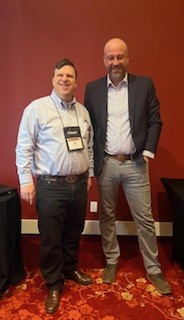
2/26/2026 10:30 AM – Mike McKevilly, PLS – 2015 LSAW Past President
mikem@sittshill.com – 253.474.9449
Mike presented the list of people who are on LSAW’s legislative board.
He then indicated that they are using a software service that assists to easily track by key word when a bill that may be of interest comes up and then assists with tracking it. Though, the watching …
Deregulating Licensing Issue:
Threats on the right is a libertarian issue. Threat on the left is that you should be able to get a job. The left is more receptive to realizing that have strong licensing standards means that there is better quality of projects like bridges.
Architects and Engineers Legislative Council (AELC).
The Architects and Engineers Legislative Council is an organization of design professionals and firms who work cooperatively on legislative objectives and issues to improve business conditions in the design and construction industries.
ACEC – AIA – ASCE – ASLA – LSAW – SEAW – WSPE
Architects are the biggest player in this Christine Brewer is the chief lobbyist.
General Overview of Legislature
- The Washington State Legislature has 147 total members – 49 senators (1 per District) and 90 Representatives (2 per District).
- Democrats enjoy a trifecta of control in Olympia
- House control of 59/39
- Senate control of 30/19
- Legislative District Map
House of Rep. Leadership Positions
- Speaker of the House (Jenkins (D) 27th)
- Speaker Pro Tempore (Stearns (D) 47th)
- Majority Leader (Fitzgibbons (D) 34th
- Minority Leader (Stokesbary (R) 31st)
- Majority Floor Leaderr (Stonier (D) 49TH)
- Majority Whip (Ramel (D) 40TH)
- Deputy Minority Leader (Corry (R) 14TH)
Senate Leadership Positions
- Lt. Governor (President of Senate – Heck (D)
- President Pro Tempore (Conway (D) 29th)
- Senate majority Leader (Pedersen (D) 43RD)
- Senate Minority Leader (Braun (R) 20TH)
- Floor Leaders
- Riccelli (D) 3RD
- Short (R) 7TH
- Whips
- Nobles (D) 3RD
- Wagoner (R) 39TH
WHAT WE KNOW FROM CHILDHOOD – I’m Just a Bill – School House Rock
How a Bill Becomes Law in Washington State
Mike provided number of slides here, but the basic idea is that one should seek to get the bill pre-filed. Then the Bill’s will typically first go the policy committee … and then often a finance committee.
The Bill gets changed back and forth within each chamber and then there is a reconciliation … which can still be vetoed by the Governor.
[For anyone interested in understanding the process further, review my previous blog posts regarding 1026 – the bill which became RCW 7.28.083.]
2026 Session Deadlines
Day 1 of Session: 2026.01.12
Policy Committee Cutoff: 2026.02.04
Fiscal Committee Cutoff: 2026.02.09
Houses of Origin Cutoff: 2026.02.17
Policy Committee Cutoff – Opposite House: 2026.02.25
Fiscal Committee Cutoff – Opposite House: 2026.03.02
Opposite House cutoff: 2026.03.06
Day 60, Last Day of Session: 2026.03.12
LEGISLATIVE WATCHLIST
- PROFESSIONAL LICENSING
- PREVAILING WAGE/LABOR
- TAXES
- RECORDING FEES
- MONUMENT PRESERVATION
CURRENT CONCERNS
Surveyors in the room are most interested in watching the recording costs and monument preservations. With respect to the later, they are seeking to tie the legislation to “home affordability” … instead of being vague and overbroad as to helping “all of Washington.”
Boundary Line Adjustment process is another issue. This is not a statewide standard, but according to county standards. This is a great idea, but as a practical means, one would have to make sure that all of the counties are on board and are not going to oppose it. Then get the bill language hammered out and find an appropriate sponsor. Think through any possible opposition and sell them so that they see the bill as advantageous. Then after the bill is dropped, make sure that you count votes in committee … that’s where bills go to die – in committee. Finally, the bill will come out and be voted on the floor of the chamber in which it was introduced … and it has to go over to the other chamber for the process before there is a reconciliation – as may be needed. And of course, if the bill runs this gauntlet … the Governor can still veto it. Note: This would probably have effects on professional liability rates because it becomes a higher standard. 2/26/2026 11:54 AM – Closed a Few Minutes