gray-large.pngI spent the better half of last week at the annual conference of LSAW (Land Surveyors Association of Washington). While there, not only did I have the chance to listen to some interesting presentations, I was given the opportunity to give a presentation on adverse possession … twice.

As surveyors are often the people that identify the titular lines of property which on many if not most occassions are not necessarily in accord with recognized boundary lines, adverse possession is a legal doctrine of significant interest to them.

In preparing my comments for an earlier presentation of this talk, I came to realize something truly bizarre about the new adverse possession law. It is this. Though this statute is placed within RCW 7.28 and thus ostensibly pertains to actions to quiet title and all the emotion that went into it as it progressed legislatively was to make the law more difficult for adverse possessors, the actual language of the statute which relates only to when a claim of adverse possession is made helps adverse possessors!

When a claim of adverse possession is made two things may happen at the discretion of the Court. After sufficient evidence (albeit that which may not necessarily clear, cogent, and convincing) is given for its ruling, the court may first make a ruling which relates toward the amount of taxes that the title holder had overpaid.

Well, in my opinion this first part regarding taxes was always a rather silly quest. Here, “the juice isn’t going to be worth the squeeze.” This is to say the cost of hiring an expert witness to fight this out is going to in most cases be more costly than the gain. Moreover, we are not looking at the loss of the value of the land. We are simply looking at the loss of the money that has been paid to the tax-man while the land has been in the actual possession of the adverse possessor. No big whop!

However, the second discretionary tool identified for the court is a “big whop”! It suggests that the court may shift reasonable legal fees and costs to the prevailing party in cases where adverse possession is claimed.

Query: Who claims adverse possession? Answer: The putative adverse possessor.

What does this mean? My reading of the statute is that only the putative adverse possessor may put the negotiating strength of RCW 7.28.083 into play.

In other words, if the adverse possessor has a strong case, well then the adverse possessor should go ahead and claim it because he, she or they can use RCW 7.28.083 to strike sufficient fear in the title holder of a possible “double down situation” (i.e. potential threat of having to pay both the title holder and the adverse possessor’s attorney fees and costs) that the title holder may give up.

Noticeably, this will also likely mean that some people with lousy adverse possession cases will try to still gain this effect by the superior huff, puff, and bluff of larger law firms who may be generating more value by the petty pretty nature of their stationary than that of their legal analysis.

The third route that may occur is to look to one of the other means of doing a non-written form of litigous boundary adjustment. These include: common grantor, parole agreement, estoppel in pais, laches, prescriptive easement, and mutual recognition and acquiescence.

The final point that I made to surveyors is that because this third route involves legal doctrines almost completely bereft of jurisprudential precedent, clients are going to be fairly anxious about their attempt. So, what can be expected…

I suggest that there will likely be many more second opinions (i.e. contra-party surveys performed). Now fortunately surveyors are fairly collegial and they rely on each others work.

But, these are hard economic times for folks that have businesses which ride on the waves of the real property markets. So there may be some people who may identify alternative – perhaps justifiably – means of interpreting title descriptions which may “better” assist their clients.

It then may come down to dueling surveys where each surveyor is called to defend his or her position in court and seeks to tear down that of the other surveyor.

In the legal arena, we realize that this is not personal. Yet we are at pains to remind ourselves that we should be more civil to our fellow legal colleagues. In other words, though trained not to, we also can find ourselves caught up in the emotion of it all at times.

All said however, surveyors don’t strike me as being so finely acculturated as to be able to mercilessly cut out each others spleen in the morning and then go out for drinks in the evening. That’s a pleasant collegiality that is generally the preverse of only lawyers, investment bankers, and aluminum siding salesman. What do you think?gray-small.png

Joshua Tree Grave 2012.jpg


justice-smiles-gold-large.pngMy family all got together for my brother’s birthday in Palm Springs over the mid-winter vacation. One of our outings was to Joshua Tree National Park which as many know has been made famous by U2’s album.

Well, I can’t offer anything better than my best Gomer Pyle — Surprise, Surpise, Surprise. Why yet again, there is evidence of a boundary dispute!

Unfortunately, this boundary dispute went a little more than sideways. For those of you that skipped right over the above picture. Take a second look. It’s a grave marker with an epitaph, written by the gunner himself, which states:

Here is where Worth Bagly Bit the dust at the Hand of W.F. Keys May 11, 1943

Hmm, well good ole’ Bill Keys spent some time in prison, but was later granted a full pardon. Perhaps he rightfully felt that the gold on his property was sufficient to:

  • Sacrifice 5 years of his life;
  • Induce the Governor to allow his pardon [here I merely speculate]; and
  • Commemorate his “Victory” forever.

 What do you think? To what extent do you want to ‘kick up the dust’ with your neighbor?justice-smiles-gold.png

orange-big.png

I received an important comment to my recent post “Survey Says the Fence Encroaches – Now What?“. I think that commenter Scott D. Warner, R.L.S. Senior Director / Editor Land Surveyors United (www.landsurveyorsunited.com) has made such an important point that I want to reproduce it here, so that it won’t be overlooked. He states:

A survey should not say that something encroaches. In matters of encroachment, I would prefer that my peers in the land surveying profession refrain from using the term “encroachment” on survey maps, plats, etc. An encroachment is a legal condition, not a matter of survey, and thus should not be identified as such by a surveyor. A man-made structure, large tree, or anything else that a land surveyor can “see” during the course of a survey on the ground should be identified on the map, plat, etc. as exactly what it is, e.g. shed, tree, electric transformer; a distance should be denoted on the plat to the effect of the horizontal relationship between the boundary of the survey and the structure without expressing legal opinion.

Scott is absolutely correct! While surveyors identify ‘Potential Encroachments’ which appear to straddle boundary lines, whether ‘Potential Encroachments’ are ‘Actual Encrochments’ is subject to legal interpretation.

So, in these types of situations, the surveyor identifies relationships between the boundary line and ‘potential encroachments’ at a (relative) moment in time.

However, to identify whether these ‘potential encroachments’ are still encroachments or have served as facts sufficient to perfect possession by adverse possession (or one of the other lesser used non-written land transfer methods) or use by prescriptive easement, is the arena of the lawyers (i.e. the practice of law).

A layman may not be too keen on the separation of these two functions, but woe onto the surveyor who oversteps his or her mark into the domain of lawyers … this is considered practicing law without a license.

Just as pointedly, woe onto the attorney who – on behalf of his or her client – “advocates” for the land surveyor to dispense with their unbiased judgment and cajoles him or her to indicate a boundary line favorable to the client.  

Thanks for your comment Scott D. Warner. I hope you will continue to offer your thoughts in the future and that others will as well. Cheers! orange-small.png

black-big.pngAdmittedly, I am not a live blogger. However, I just finished watching the Senate Judiciary Open Hearing on what is now SHB 1349 on TVW. And because I had sent along my previous post to the office of the bill’s sponsor WA House Rep. Jeff Morris of the 40th District, I felt a little bit like Ed Harris’ character in The Truman Show with Jim Carrey

After the legislative assistant introduced the bill, Rep. Morris took over and things seemed to go just fine. He indicated that while he is not wed to Oregon’s code, he thought since our respective states were cut from the same cloth [which surveyors can litterally attest to this by pointing to the Willamette Meridian], the Oregon code is likely a good starting place.

After answering some of the questions, it appears that Senator Cheryl Pflug of the 5th Legislative District offered some practical thoughts about having people that use the first portion of road (i.e. all) pay for that, and then the next portion of road paid by those who use that part (so that those at the top of the road don’t have to bear their costs) and so on down the line.

So, it isn’t clear exactly how this bill’s language is going to spin out. However, Senator Pflug did suggest some sort of mediation process be incorporated in to it. Senate Judiciary Chairman Adam Kline then indicated that this default language prevents litigation. So, in that both of these members have different letters behind their names, it is likely that the Judiciary Committee will sort this language out somehow and go forward. What do you think?black-small.png

justice-smiles-green-large.png

A Boundary Line Adjustment (“BLA”) requires that both your property and your neighbor’s property be surveyed. Surveyed not just as to the boundary line. Surveyed not just as to their respective ‘footprints.’ But instead, surveyed as to all of that – as well as all fixtures.

Q: What’s a fixture? A: Anything that wouldn’t fall off your land if you turned it upside down and shook it! In other words, your house, your garage, your shed, your walkway and drive, your fence … .  That’s a lot of survey work!

Then, you will have to make an application – and pay its fee –  to the appropriate city, county, municipal governments charged initial review of your BLA.

Then, you might find that its been discovered that there is some sort of current deficiency. Perhaps current code requires that a new fire hydrant be placed. Well guess who is going to have to apply to have that reviewed after you (or your neighbor) has paid to have it installed.

And needless to say, if you want any assurance or guarantee as to what you may need to spend, you will likely be providing a nice set of billable hours to your attorney to research your needs.

Then after a long drawn-out process which very likely will exceed 6 months, your project might be blessed.

So, in answer to the question: Is a Boundary Line Adjustment Right for my Neighbor and Me? The answer is almost catagorically – NO!

No that is – unless you and your neighbors are cows and your land is green field.justice-smiles-green.png

justice-smiles-green-large.png

 Your survey indicates that the fence encroaches your way; your neighbor’s survey indicates that the fence encroaches in their direction; or perhaps you split the cost of a survey and you found that the fence encroaches one way or another … what should be done now?

First try to find out the following facts:

  1. Who built the fence;
  2. When was the fence built;
  3. Who all vouches for who and when the fence was built;
  4. Does everyone agree to the timeline;
  5. Is there a survey which shows the fence was in place during this time been recorded; and
  6. Is there any other physical evidence to indicate when the fence was built.

Who built the fence could be important because its removal might be construed as a certain type of property destruction which might allow you to claim treble damages as well as reasonable attorney’s fees and costs.

Evidencing when the fence was built, especially if in excess of 10 years, is a very significant determinant of whether or not adverse possession has been perfected.

However, there is a big difference between having adverse possession perfected and having title recognized. Based on your newfound awareness, as Rod Serling used to say: “You have now entered the Twilight Zone“.

What good is a right that is not recognized!

Well, you have four basic courses of action. They are the following:

  1. Do a Boundary Line Adjustment (“BLA”);
  2. File an Adverse Possession or Quiet Title Action;
  3. Negotiate with your neighbor and then Record an Easement; or
  4. The highly unrecommended – Do Nothing!

I will go through the benefits and detriments of each of these four choices (and will return to provide forward links to the content of each). But by way of hint, if you and your neighbor can keep your heads about you, to Record an Easement is most likely going to be your best bet!justice-smiles-green.png

Montlake.Reliction.jpg

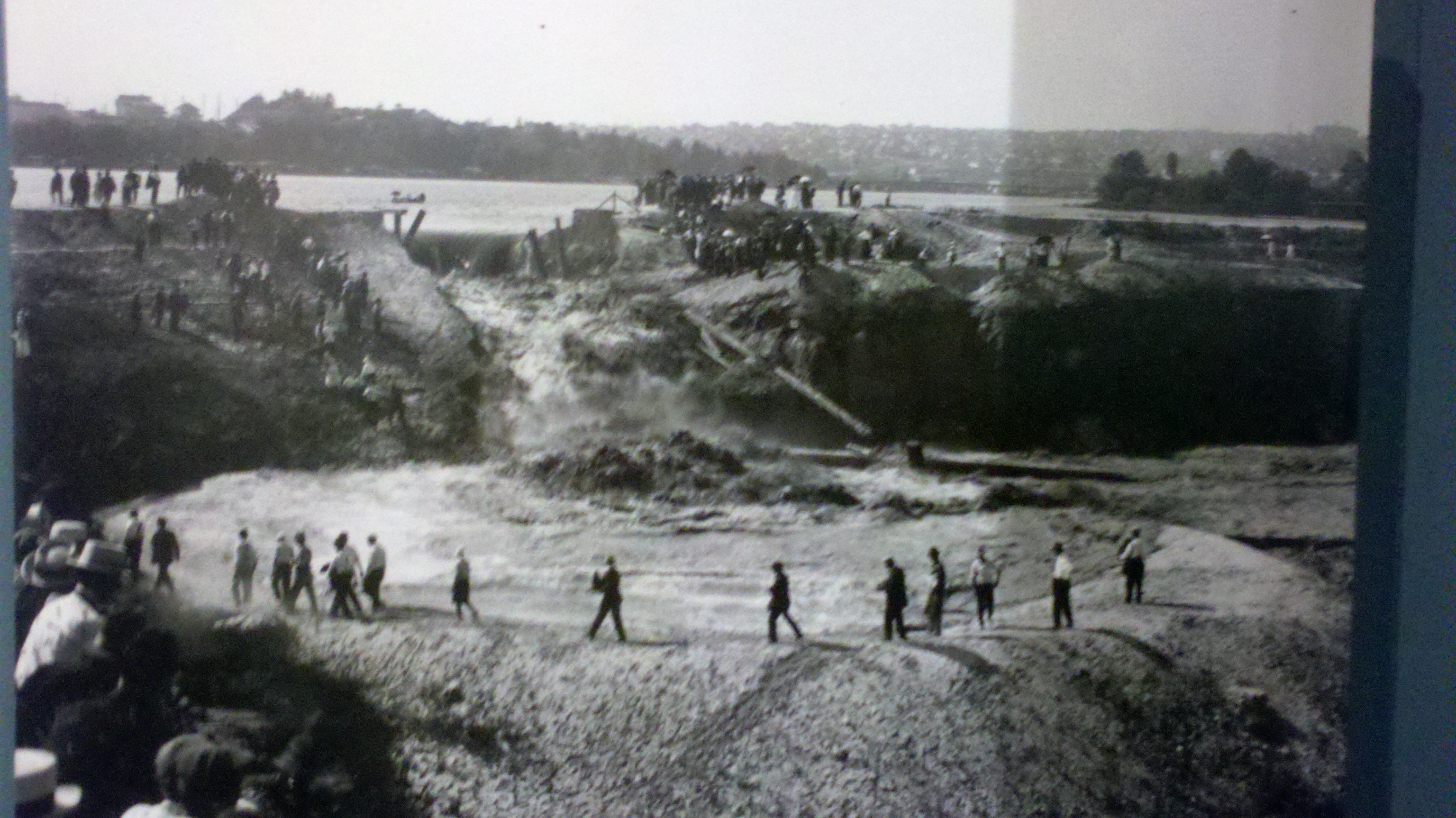
justice-smiles-blue-large.pngAbove is shot I took last weekend during a visit to the MOHAI before they start packing up for their new location. “Museum of History & Industry, #83.10.10,325 – Opening on Montlake Cut, August 26, 1916” is reproduced here at the express permission of MOHAI’s librarian Carolyn Marr. It offers an excellent means of explaining the term reliction.

Reliction is the gradual creation of land when water levels around a river or lake recede.

The picture above captures the breaking of the dam which contained Lake Washington’s waters prior to completion of the Montlake cut. Its effect was to connect Lake Washington to Lake Union which in turn connected to Salmon Bay through the Hiram M. Chittenden Locks (between Seattle’s Ballard and Magnolia neighborhoods) thus suddenly dropping the water level.

By dropping the water level in a hurry, submerged land would quickly be accessable. Who was to own this land? The case that decided this was: State v. Sturtevant, 76 Wash. 158, 135 P. 1035 (Wash. 1913). The case notes:

The right to control navigation is admittedly in the United States, but the people of the state of Washington have asserted ‘ownership to the beds and shores of all navigable waters in the state up to and including the line of * * * ordinary high water within the banks of all navigable rivers and lakes.’ Constitution, art. 17, § 1. This declaration destroyed all riparian right in tide and shore lands, and affirmed the right of the state to absolutely control and dispose of these lands in any way or to whomsoever the Legislature might ordain.

However, the case then goes on to acknowledge that the State’s consitutional drafters were not considering an event like this. And here the term event is important.

As stated earlier, Reliction is the gradual creation of land when water levels around a river or lake recede.

Now, surveyors that work around water have to make decisions about how to equitably redraw lines when they return after many years to find a relicted lake or river – but that’s a subject for another time. The disposition in this case turned largely on this stated recognition:

The value of shore lands in most instances lies in the fact that ownership gives access to deep or navigable water. The state has sold and the purchaser has bought believing this to be true. The right of a riparian proprietor or a shore owner to improve up to the line of navigation and to erect docks and piers, though sometimes denied, is now well settled.

Washington’s Supreme Court determined that the upland real property owners, and not the state, owned the land … which was to be quickly created.

Yes, that’s right – which was to be created. Notice again the date on the case – 1913 [October 25th to be exact] – and the date on the picture – August 26, 1916. Indeed, this was an anticipated event which generated attention and quite likely a great deal of anxiety as to affected people’s real property rights.justice-smiles-blue.png

justice-smiles-red-large.pngThose of you living in the greater Los Angeles area in a serious dust-up with your neighbors might be interested in this; a casting call for which you may fit the bill.

 Is it hard to love thy neighbor?

Major network is now casting a brand-new documentary series that aims to resolve ongoing conflicts with your neighbor.

If you’ve run out of ideas to outwit, outsmart, or just plain survive the never-ending diatribe with your neighbor (or get them to find a new home!), we’re here to help! With the assistance of a professional mediator, we can turn your life – and your neighborhood – around.

If you or someone you know is engage in a neighborly tiff, please contact sandy@metalflowersmedia.com or log on to www.metalflowersmedia.com.

Suspecting that I may be receiving the spam equivalent of Ghostbusters’I’ve been slimed“, I called up Sandy to see if this is legit. She indicated that while her group is not at the point where they can disclose the network, chosen participants will receive compensation.

So, without providing endorsement (at least for the time being), I am passing this info along and leave it to those of you possibly qualified to consider pursuing this further as you deem appropriate. Good luck!justice-smiles-red.png


black-big.pngKerry Randall a mortgage banker for Peoples Bank dialed me in to a new bill that is working its way through Olympia’s legislative python.

HB 1349, which is sponsored by WA House Rep. Jeff Morris of the 40th District, seeks to provide a legislative default for private road maintenance agreements when one does not already exist.

The rationale which Rep. Morris gave for his sponsorship of this bill in his testimony to the House Judiciary Committee (which you can find presented after the legislative assistants testimony beginning at 37:20 here) was this.

In order for banks to lend money real property which are adjacent to private roads, they often will require that a road maintenance agreement be in place. The reason for this is that if access to real property is denigrated over time, the value of the real property itself will be too.

So, if you had a dilligent developer that went through this step – you are in luck. But, in that this is an extra cost for a benefit generally unknown by the general public as to its importance, it may have been conveniently forgotten.

The hope then is that this bill, which Rep. Morris indicates is modeled after Oregon’s code, will eliminate bank’s fear that the property will be difficult to resell when this agreement is not in place.

Now, I will say upfront that I have not taken a fine look at the language of this bill. (Which is to say, I haven’t read it and let it sit long enough to think through all the angles.) However, I do believe that something of this nature is very valuable.

The reason is to remove what in economics is called a free-rider problem. An example of this is the negligible costs associated with filling an empty seat in a bus, plane, or movie-theatre. When that seat is not sold, the benefit to the free-rider is great and the immediate cost to the company – or in this case the other homeowners – is small.

Except, now that Jimmy doesn’t have to pay his fair share, Sally might think that she should play the same game. The result is an almost complete fall down where nobody is willing to ‘buck-up’.

Now in the case of a private road this can become even more pronounced if one of the neighbors is seeking to get a road maintenance agreement signed off by his or her current neighbors.

This is because these neighbors will suspect an imminent departure – hence they will no longer be living proximate to the land owner seeking the agreement. The result is that they may even have the audacity to ask for the receipt of some sort of compensation for their signature.

Why? Because in the case of a private road, there is some sort of ownership, even if not spelled out in writing. And what pray-tell is that likely going to be?

I will certainly allow myself to be corrected, but I suspect that 90% or more of the time the private road is owned jointly by everyone who has private property that either abuts its center-line or its edge.

And folks, what this means is that each and every owner of the private roadway through the magic of the legal fiction called ‘joint ownership’ owns each and every square inch of that private roadway to an equal degree.

The result – even though it does not make sense when numbers exceed say 3 or 4 people – is that there are no rules in place. Result: CHAOS!.

People may, and often do seek to use the private roadway in all different sorts of ways. Believe me, I have had experience with this and it is not at all pretty!

So, where do things now stand with HB 1349? It has been modified and approved narrowly in the House. So, it now must go through the vetting gauntlet of the Senate Judiciary Committee before it passes to Rules – if at all. 

Interestingly, at the House Judiciary Committee, Rep. Morris testified alone and was not asked any follow up questions. I should think that the Real Estate and Title Insurance communities should take a more active approach. Which leads me to wonder if they are informed of this bill. 

This is certainly a bill, which if properly thought through will assist their efforts to keep real property alienable (i.e. able to be sold). So, I will be curious to see if there is a bigger testimonial turn-out at the Senate Judiciary hearing. What do you think?black-small.png

orange-big.png

A survey is authenticated not by the fact that a surveyor’s stamp is upon it. This alone is inadequate.

In addition to the stamp, the surveyor must place his or her signature and the handwritten date of the survey’s completion across the stamp.

Notably, in the past the expiration of the surveyor’s current license (which must be renewed every two years) had to also be included.

Vic Banks who is retired but remains active as teacher in the survey field, related that this expiration date could be handwritten, but was usually placed within the stamp itself.

Yet, I noted that some of the more recent surveys did not have the expiration date on the stamp. It appears that at some point the legislature dropped the requirement that the expiration date be on the survey stamp itself. RCW 18.43.070 states in pertinant part:

It shall be unlawful for anyone to stamp or seal any document with said seal or facsimile thereof after the certificate of registrant named thereon has expired or been revoked, unless said certificate shall have been renewed or reissued.

So, it appears that if there is a reaon to question the authenticity of a survey in full (as opposed to components within), one means would be to seek to disaffirm that the surveyor was in fact licensed during the date that the surveyor affixed his or her stamp, signature, and date to it.

Moreover, where there is simply a survey with a stamp and nothing else, the survey certainly is not self-authenticating.

In such a situation, the question becomes whether the Court will or will not allow it in as parole evidence. I would be interested to hear more about how successful that attempt has been in the past. If you have any experience as a surveyor or as an attorney in this regard, please feel free to share.orange-small.png